

As defined before Helinks STS bases the communication generation over 2 main principles :
-
the specification
-
the IED specificity
The communication configuration will impact these points :
-
Control Block creation or usage
-
Dataset creation or usage
-
GSE, SVM creation or usage
-
ExtRef creation or usage
-
InRef creation or usage
-
LGOS / LSVS creation or usage
You can use the Communication Editor to check the generated communication.
The compilation of the IEC61850 communication is done by the tools bar button “Set SCL communication from specification”.

This will open the Communication Configuration Setting dialog where you can customize the communication generation.
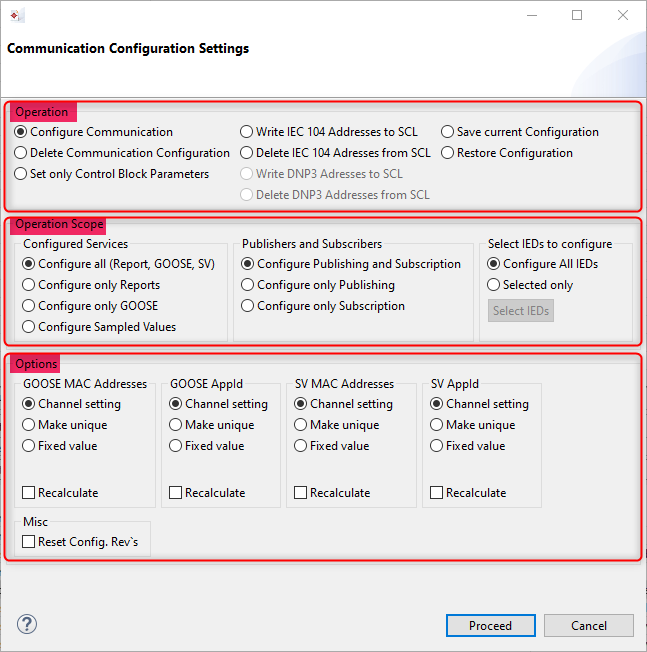
This Dialog contains 3 main customization sections (Operation, Scope, Options).
Operation
The operation determines the action that will be performed
-
Configure Communication will create the communication (ControlBlock, dataset, extref,…)
-
Delete Communication Configuration will delete the existing communication configuration (ControlBlock, dataset, extref,…)
-
Set only Control Block Parameter will not change the current communication configuration by creating or using element (ControlBlock, dataset, extref,…) but will only adapt the control block parameters.
-
104 action will write/remove 104 addresses in SCL
-
DNP action will write/remove DNP addresses in SCL
-
Save current configuration will backup the current project to the Archive folder
-
Restore configuration will restore an old version of the project from the Archive folder
Scope
The scope defines on which element the operation is applied. The scope is subdivided into 3 areas (Services, Publisher Subscriber, IED selection).
-
Services determine which service will be impacted by the operation
-
Publisher / subscriber determine which side (publisher / subscriber) of the service will be impacted by the operation
-
IED selection determine on which IEDs the operation will be applied
Options
The options allow to customize specific parts (GOOSE/SV mac addresses, appid) of the communication generation with global algorithm.
-
Channel setting uses the information stored on the service specification channel of the application to determine the generated value.
-
Make unique ensures a unique value during the generation process
-
Fixed Value forces the generated value to a specific value
Channel setting is the preferred option.
By default the communication configuration algorithm restore APPID and MACAddresses if a previous generation was done. The recalculate check box allow to bypass this process and force the recalculation.
Access Point-level Services
Communication Configuration now properly respects the publishing and subscription capabilities defined at the Access Point level. If Services elements are defined within individual Access Points (rather than only at the IED level), the configuration engine uses those Access Point-specific capabilities to determine what each access point can publish or subscribe to.
This is particularly relevant for IEDs with multiple access points that serve different communication roles (e.g., a station bus AP for GOOSE and a process bus AP for Sampled Values).