

Top-down and bottom-up are two different approaches to systems engineering which both offer distinct advantages and disadvantages. This chapter contains a short explanation of each approach, and outlines how Helinks STS can be leveraged with it to increase productivity.
Bottom Up
Basic Explanation
-
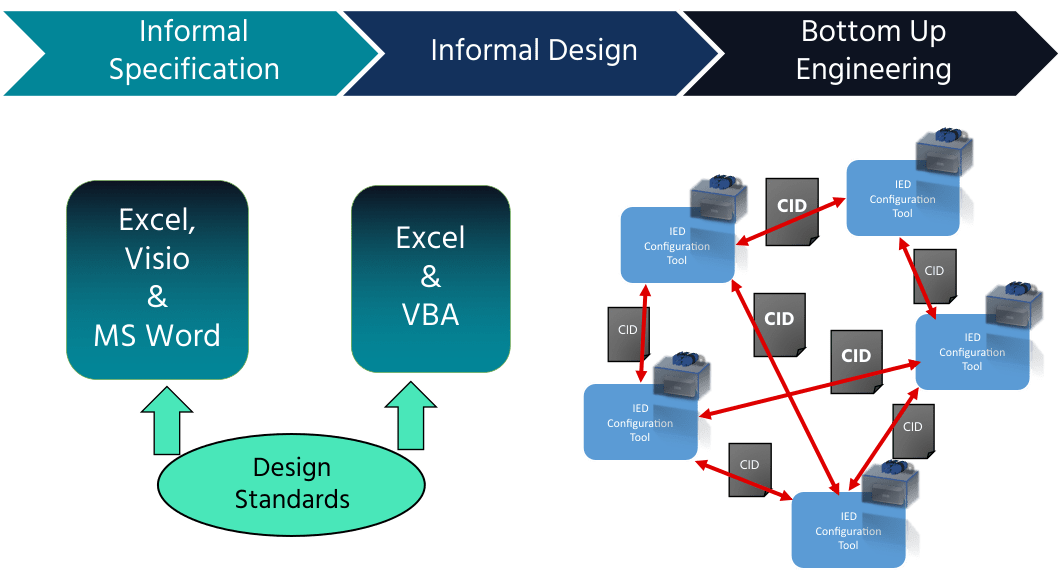
Specification consists of informal documents (Excel, Vision, etc.)
-
System Integrator or Vendor generates all design and tests to meet the specification
-
IEDs are engineered directly with all Datasets, Reports, Goose and signal flows using the IED Configuration Tool (ICT) provided by the vendor
-
CIDs are exchanged multiple times between IEDs to set up subscriptions
Advantages
-
Allows for a faster learning experience to build up basic competency in IEC61850
-
Higher initial flexibility, allows for easier changes (good for brownfield, or ‘one-off’ cases)
-
Higher immediate practical application
Disadvantages
-
Design changes require significant re-engineering
-
Change management for engineering standards is significantly more difficult
-
Low reusability of engineering for subsequent projects
-
Scales poorly with the complexity of a project due to high number CID exchanges
Top Down
Basic Explanation
-
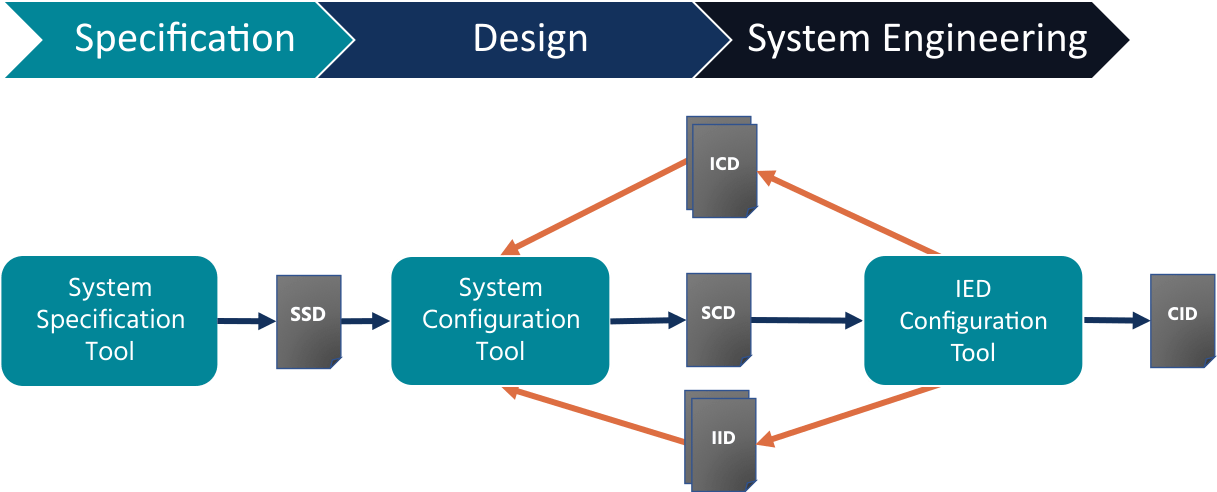
Create a formal specification in the form of a Substation Specification Description (SSD) file
-
IEDs are imported as IED Capability Descriptions (ICDs) and engineered in the System Configuration Tool (SCT)
-
SCT creates a Substation Configuration Description (SCD) which is used with the ICT to configure the IEDs
-
IED Instance Descriptions (IIDs) and the SCD may be exchanged multiple times to complete the process
Advantages
-
High reusability
-
Design iterations are simple
-
Reduced whole of life costs
-
Results can be simulated and tested early to match requirements
Disadvantages
-
Higher initial costs
-
Higher initial design time
-
More difficult to apply to brownfield sites